


The year’s close naturally brought with it reflection on where we currently stand as a field, as a society, and as knowledge creators. For me, one pattern kept surfacing: 2025 felt like the year we doubled down on a bet that isn’t quite paying off. AI continues to fail to deliver its promises, yet we keep investing more resources, more energy, and more institutional capital into the assumption that this technology will eventually win out. And I found myself wondering: what would happen if we put that same energy into valuing human experience and human expertise?
Exemplification versus Expansion
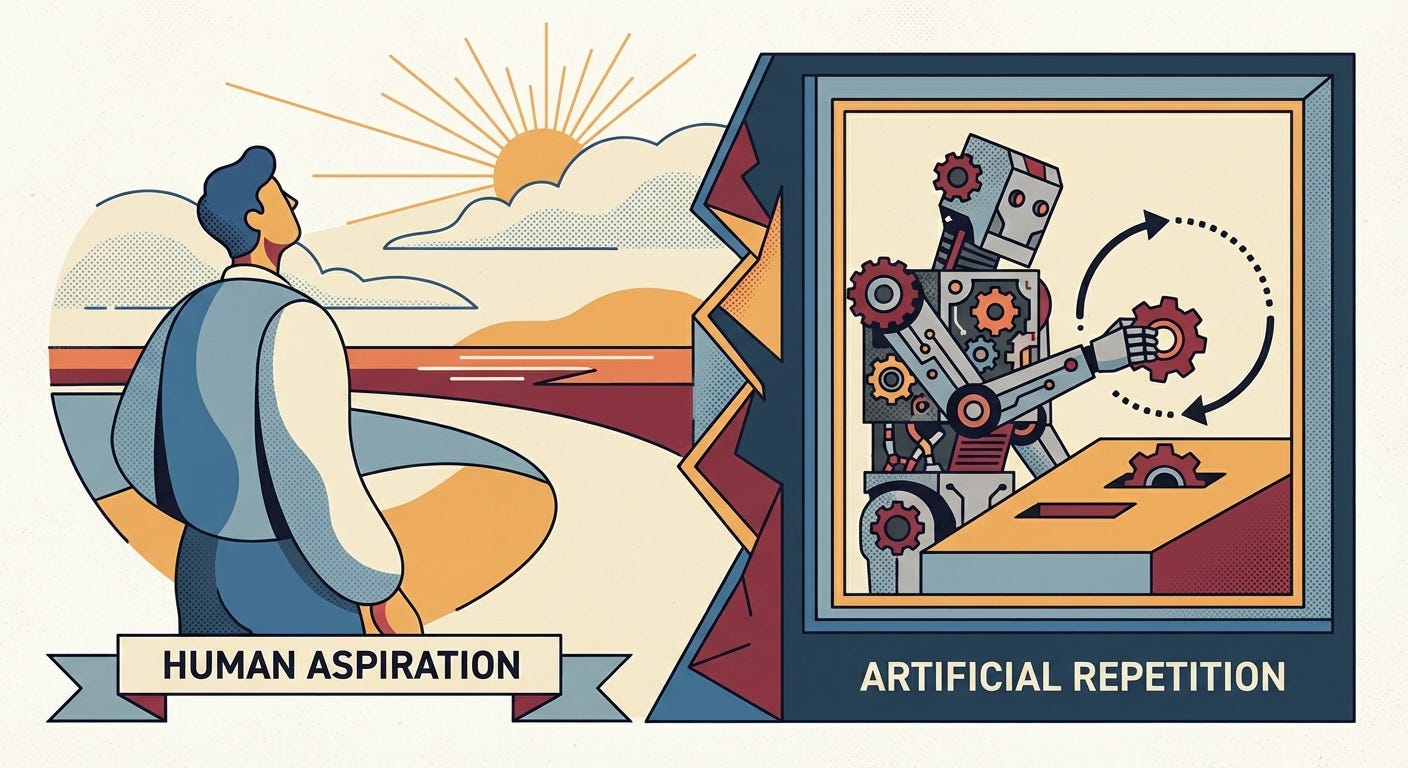
There’s something about AI in its current form that feels fundamentally different from other technological revolutions, and it took me most of the year to articulate what it is. When I look at history’s other transformative technologies—railroads or the internet, for instance—they expanded human capability. Railroads let us travel farther and faster than we could before. The internet engendered novel means of connection and communication. They didn’t try to replicate what humans already did; they enabled entirely new possibilities.
Thus far, however, AI has followed a different pattern. We’ve spent most of the last several years trying to imitate what humans can do (coding, writing, data analysis, customer service, research) rather than expanding our capabilities in new ways. This distinction matters more than I initially realized. It’s the difference between the steam engine (which opened new horizons) and the mechanical loom (which replaced what skilled textile workers had spent years learning). One amplified human capability while the other mimicked it.
To me, this is part of why the current resistance to AI feels different from past technological skepticism. When I tell someone from an AI company what I do, they inevitably come back with something to the effect of “A computer could potentially do the same thing.” But they’re missing the point entirely, and the narrowness of that response reminds me of the story of Pablo Picasso who, when asked to sketch something quickly in exchange for just a few dollars, said, “No, it took me a lifetime to draw this.” The value of what he made resides not solely within the product output, but rather in the creativity, training, judgment, and experience that led to it in the first place.

Institutional Noise
Running a lab this year while watching talented researchers leave academia for industry has led me to think a lot about sustainability—not environmental sustainability per se, but the sustainability of knowledge creation itself. Industry claims to value these researchers more than institutions do, but I’m not convinced they actually value the right aspects; namely, their ability to think critically, develop new knowledge, support learners, and tolerate the uncertainty that real research requires.
What industry often values is something more extractive: the ability to apply existing knowledge to immediate problems, to produce results quickly, and to fit into systems optimized for efficiency rather than discovery. Meanwhile, the institutions like the NIH or NSF who are supposed to nurture the next generation of knowledge creators have been destabilized by the disruption of long-validated paradigms, diminishing research support, and leading to more uncertainty than stability.
There’s been a lot of noise this year. Institutional uncertainty. Funding questions. Political chaos affecting everything from research priorities to who can access healthcare. And as a result, I’ve watched people leave because they’re exhausted, because they need stability, and because the institutions that should value knowledge creation seem to value everything else instead.
The False Equivalency
What concerns me most is the fundamental false equivalency we’ve accepted: treating language pattern matching as equivalent to human imagination, problem-solving, and lived experience. Large language models may be able to generate text that looks like expertise, but they’re fundamentally different from the process that creates actual expertise. They’re copying, not discovering. They’re replicating, not developing.
This matters because we’re building trillion-dollar industries on appropriated human knowledge while systematically devaluing the humans who created that knowledge in the first place. Right now, AI companies optimize for reach and user acquisition, building value by extracting content that people previously created and shared freely, then using it to build systems that might replace those same creators. That’s not a sustainable knowledge economy; it’s a knowledge extraction bubble.
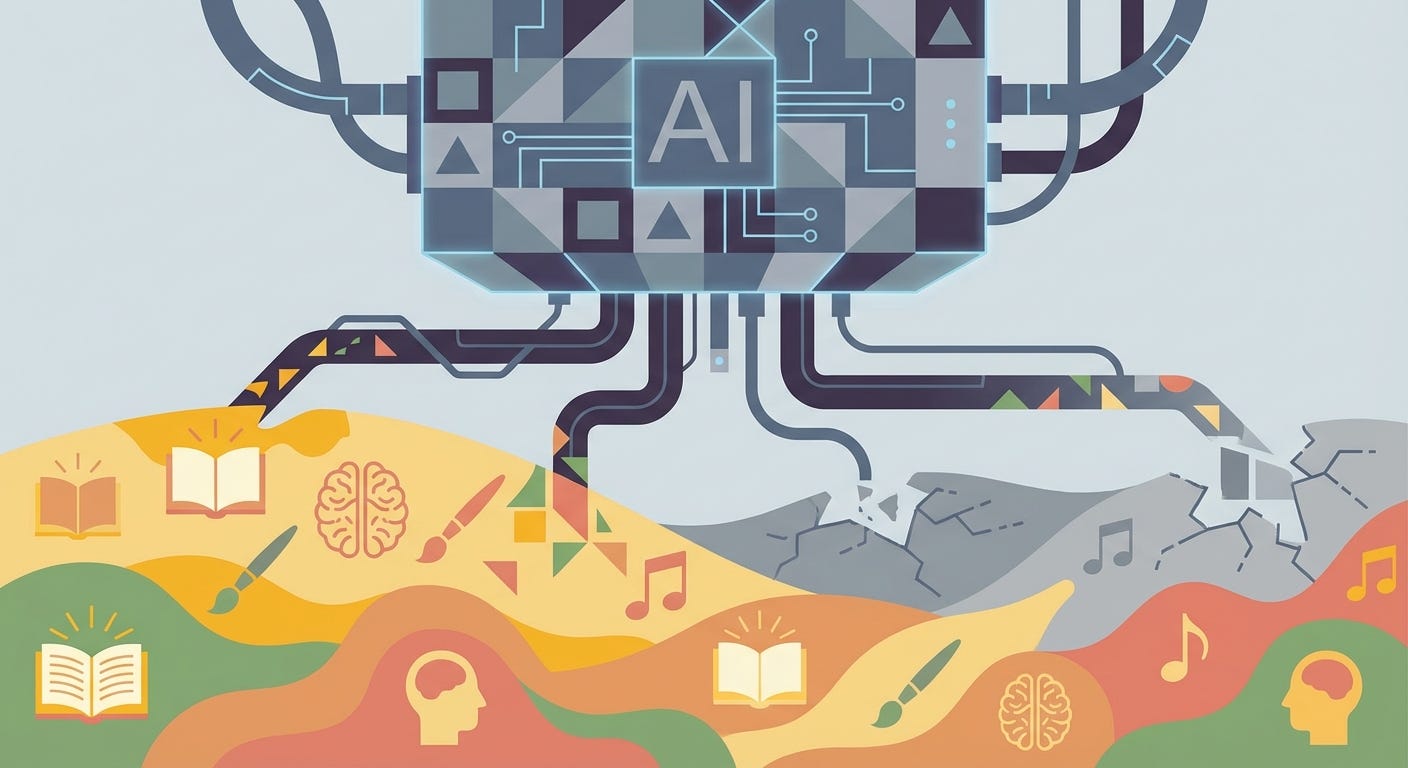
I apologize for the bubble analogy, but it’s what comes to mind. We’re investing massive resources into systems that primarily replicate existing human capabilities while undermining the very mechanisms that create new knowledge in the first place. If everyone stops authentically creating and sharing knowledge because “AI can do it,” what do future AI systems train on? What happens when we’ve extracted all the easily accessible human knowledge and haven’t built sustainable ways to generate new insights?
A Different Question for 2026
So, in 2026, I’m hoping that we begin to ask a different question. Instead of “How do we make AI do more things humans do?” we should be asking “How do we build systems that make human capabilities more valuable and irreplaceable?”
What would a truly new and augmented AI look like? It might enable new scales of analysis impossible for humans alone. It might connect information across distances and domains that humans haven’t yet been able to bridge. It would augment human decision-making with computational capabilities while respecting the judgment, creativity, and lived experience that only humans can provide. It would create new mediums for human expression rather than trying to replace human expression entirely.
As someone deeply entrenched in technological development, I promise this isn’t about resisting technology; it’s about building the right technology. History shows us that technologies succeed when they expand rather than extract, when they value rather than replace human expertise. Portrait painters adapted to photography by emphasizing artistic vision and emotional interpretation that cameras could never capture (alone, at least). Musicians emphasized live performance and human connection that player pianos couldn’t replicate (though watching keys pressed in perfect time feels like being in the Haunted Mansion). In each case, the adaptation involved doubling down on uniquely human elements rather than trying to compete on replication.
Signal Over Noise
My hope for 2026 is simple: more signal, less noise. More focus on the human capabilities that create lasting value, less obsession with replicating what humans already do. More investment in sustainable knowledge creation, less extraction of existing knowledge without compensation or recognition.
I hope we recognize that the discomfort of learning, that original thinking requires struggle, that the messy process of human creativity isn’t a bug to be optimized away. These are its features. They’re how humans develop capabilities that can’t be replicated by pattern matching, no matter how sophisticated the model.

And personally, as a member of a team who mentors the next generation of researchers, I hope we build institutions that actually value knowledge creation rather than treating it as something to be extricated and automated. Because ultimately, all AI systems in the world depend on humans continuing to think, create, question, and discover. If we make that unsustainable, we’ve optimized ourselves out of the very process that makes progress possible.
This year, I’m hoping we spend less energy figuring out whether computers can do what humans do and more asking how we make what humans do more valuable, more sustainable, and more central to how we build our technological future. Because the most important innovations won’t come from better pattern matching—they’ll come from better supporting the humans who can imagine possibilities that don’t exist yet in any training data.
-----
*Of course, many of these themes deserve deeper exploration. We’ll be diving into those in future pieces throughout 2026.*