


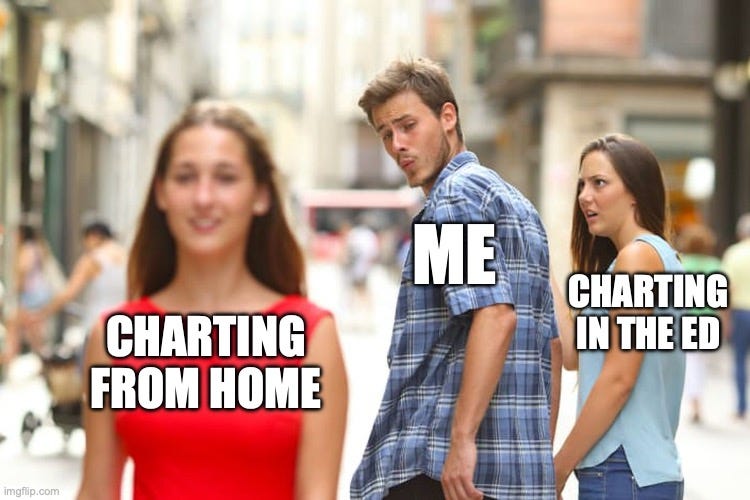
It's 4 PM on a Thursday, and yet here I am posting this from my home office. I just finished reviewing patient charts from yesterday's shift—not because I'm behind or overwhelmed, but because this is when I do my best thinking about complex cases. Away from the noisy and interruptive emergency department, without the pressure to discharge patients or the constant barrage of questions, I can actually reflect on whether that subtle presentation might have been something more serious.
Does this make me a worse physician than my colleagues who power through everything before leaving the hospital? Our research lab just analyzed millions of audit log events from our electronic health records, and what we discovered might challenge our assumptions of "pajama time."
The Patterns We Keep
When we mapped physician charting behaviors across thousands of shifts, a striking pattern emerged. Physicians aren't randomly distributed along a spectrum of after-hours work. Instead, they cluster into two distinct camps: those who consistently chart after hours (about 20-30% of their work) and those who almost never do. The correlation was nearly linear—the more you chart after hours, the more consistent that pattern becomes.
"I wait a day to sign my charts," one colleague explained during our analysis. "I give it time to percolate, see if I need to call anyone back. If I'm sitting at home and remember something about that patient with abdominal pain, I can add it without the pressure of ten other people waiting."
This isn't procrastination or poor time management. It's a deliberately chosen workflow that some physicians have optimized over years. And here's where it gets interesting: preliminary connections to our burnout data suggest these consistent after-hours charters might not be the ones suffering most.
When Boundaries Become Bridges
The conventional wisdom in physician wellness is clear: work-life boundaries are sacred. Every minute spent charting at home is a minute stolen from recovery, family time, or self-care. But what if we've been measuring the wrong thing?
Our data revealed that attending physicians working with residents show different patterns entirely. During shifts, they're primarily reviewing and supervising—their actual documentation happens later. One attending's heat map showed almost all their direct charting occurred after hours. When asked, one attending responded: "That's my decompression time. I pour a glass of wine, review the day's cases, and actually think about what happened instead of just trying to survive it."
A colleague commented that this mirrors findings from ambulatory care, where physicians with children often prefer evening documentation after bedtime. They report feeling more present during patient encounters when they know the administrative burden can wait for a quieter moment. The issue isn't the after-hours work itself—it's whether that work is chosen or imposed, controlled or chaotic.
Let's be clear: this is still work. Whether it happens at the hospital or at home, whether it's at 3 PM or 2 AM, documentation and clinical reasoning are labor that should be recognized and compensated as such. The physicians who've optimized their workflows to include home charting aren't doing it because they love unpaid overtime—they're making the best of a system that demands more cognitive work than can reasonably be completed in a chaotic clinical environment. The fact that some have found ways to make this sustainable doesn't absolve healthcare systems from addressing the fundamental issue: if the work requires quiet reflection and careful thought, then either we need to provide that environment during paid hours, or acknowledge that 'after-hours' charting is actually 'required-hours' work that just happens to occur at home.
The AI Disruption
As we roll out ambient AI scribes like DAX across our department, these patterns are shifting in unexpected ways. Physicians report a fundamental change in their relationship with documentation. "I don't have chart anxiety anymore,"one early adopter explained. "The AI captures the basics, so when I review at home, I'm editing and reflecting, not frantically trying to recreate conversations from memory."
The technology doesn't eliminate after-hours work—it transforms it from a memory test into a quality review. Physicians who previously stayed late to document are now leaving closer to on time, then spending 20 minutes at home refining AI-generated notes. Same time investment, radically different cognitive load.
Our preliminary data suggests this shift might explain why some physicians maintain their after-hours patterns even with AI assistance. They've discovered that the issue was never the timing—it was the mental burden of trying to accurately reconstruct patient encounters while juggling ten other priorities.
Beyond the Clock
What our data reveals is that physician well-being can't be reduced to simple metrics like "hours worked after shift." Some physicians thrive with clear boundaries, completing everything before leaving. Others have crafted sustainable rhythms that include deliberate after-hours work in a controlled environment of their choosing.
The path forward isn't to eliminate all after-hours charting—it's to understand why some physicians choose it and thrive with it while others experience it as an unsustainable burden. As we design the next generation of health IT systems and wellness interventions, we need to move beyond one-size-fits-all solutions.
Perhaps the real question isn't whether you chart at home, but whether you’ve found a pattern that lets you be fully present when it matters most—in the room with a patient, focused on your care rather than the documentation you’ll need to complete. For some of us, that means embracing a potential paradox: embracing the pajama time that makes the work time work well. We just also need to make sure that work is compensated.
In our meetings at the Human Experience and Advancement Lab, we examine where healthcare technology hype meets human reality. This piece reflects ongoing discussions about medical education, AI capabilities, and what we're really measuring when we measure medical competence.